





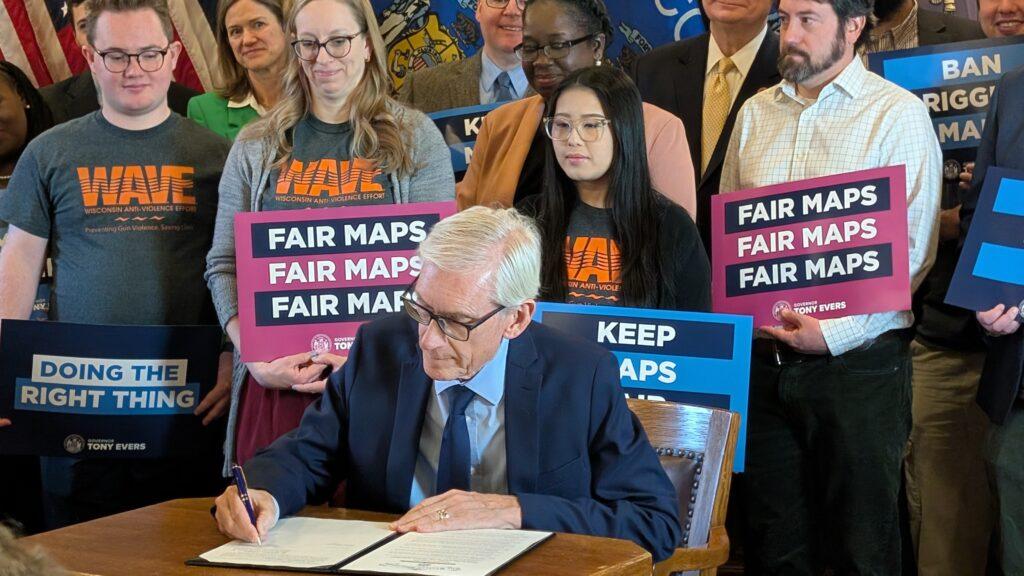


The proposed amendment would include language to expressly prohibit drawing districts that give a disproportionate advantage or disadvantage to any political party.
“There are no tricks, no gimmicks, no funny politics here,” Evers said at a press conference. “Just a straight up ban on partisan gerrymandering. Nothing more. Nothing less. I could not have made this vote any easier for the Legislature. With nine months left in the calendar year and the legislative session, we’ve got work to do.”
The executive order calls for the special session on the proposal to be held at noon on April 14. During his two terms in office, the Legislature’s Republican leaders have repeatedly spurned Evers’ special session calls on a range of issues.
Evers announced his intention to sign the order at his State of the State address last month. Constitutional amendments must pass two sessions of the state Legislature, then go to voters for consideration. If a proposal were to pass the Legislature in April, the next state Legislature, which could look very different after this year’s November elections, would need to vote on the proposal as well. Evers, who opted against running for office, would also not be in office to advocate further for the proposal.
Wisconsin adopted new state legislative maps in 2024 after the state Supreme Court ruled that the previous maps were an unconstitutional gerrymander and ordered new maps to be implemented.
The adoption of the new maps did not change the process that Wisconsin uses to draw its legislative maps, which is currently done by state lawmakers. Wisconsin Democrats last held a trifecta in the 2009-2010 legislative session and did not pass legislation to adopt nonpartisan redistricting. In 2011, Wisconsin Republicans, who won a trifecta and took control of the state government, drew the state’s maps to heavily favor the GOP, and the maps drawn in 2021 further entrenched the gerrymander.
Before passing the current maps in 2024, the state Assembly passed a proposal to implement what Republicans said was an Iowa-style nonpartisan redistricting mode. That proposal led to pushback from Democratic lawmakers, who contended it allowed for too much partisan influence on the process. When it passed the Senate, the bill had been amended to implement maps that would have protected Republican incumbents. Evers vetoed the bill.
Evers said that the maps adopted in 2024 have given each party a chance at winning control and ensured that every vote matters in battleground Wisconsin.
States must engage in redistricting every 10 years. Wisconsin lawmakers will be in charge of the process next in 2031 and could engage in partisan gerrymandering, Evers said, unless gerrymandering is banned or a new process is adopted.
“If the Legislature doesn’t act now, our maps could go right back to being rigged. Wisconsinites could go right back to living under some of the most undemocratic maps in America,” Evers said.
Evers added that he’s been “especially worried” due to recent actions being taken at the national level. President Donald Trump has pressured Republican-led states, including Texas, to engage in explicit partisan gerrymandering to ensure Republicans keep the majority in Congress in the upcoming midterm elections. In response, some Democratic-led states, including California, have redrawn or are considering redrawing their lines to combat the impact.
The Evers proposal does not specify what process lawmakers would need to adopt to prevent partisan gerrymandering, but leaves that up to lawmakers.
Nick Ramos, executive director of the Wisconsin Democracy Campaign, said at the press conference that the state needs to take redistricting out of lawmakers’ hands altogether and make it a nonpartisan process.
“It’s about fairness. It’s about equity. It’s about honoring the principle that every voice in Wisconsin deserves an equal say, no matter where you live, who you are or who you vote for,” Ramos said. “Gerrymandering is bad public policy, no matter who’s doing it, what flag they wave.”
Ramos said the constitutional amendment proposal is a “significant nod to one unifying truth that politics should stay out of redistricting from start to finish.”
“Calling a special session is one thing. Taking meaningful action is another. If this Legislature is serious, they will take this special session and not gavel in and gavel out like they always do,” Ramos said.
Evers, who is in his final year as governor, has called special sessions on a variety of issues over his time in office including abortion, gun violence and the state budget. The Republican-led Legislature has usually just immediately gaveled in and out of them without taking action or completely rewritten his proposals.
Evers said that he would seek to raise public awareness of the issue and encourage people to call on their lawmakers to pressure them into not doing the same this time.
“We’re going to work real hard in the meantime to make sure that the people of Wisconsin are talking to the legislators and making sure that they understand that this is the will of the people,” Evers said.
Assembly Speaker Robin Vos (R-Rochester) expressed some openness to discussing a proposal to address partisan gerrymandering, but was skeptical about Evers’ proposed constitutional amendment.
“This one-sentence constitutional amendment provides no details as to how this would actually work. But we’re supportive of the governor’s concept and we would be more than happy to negotiate with him to develop a plan to be voted on by the entire Assembly,” Vos said.
Senate Majority Leader Devin LeMahieu (R-Oostburg) has not responded to a request for comment.
Last week, Evers said that he had heard some pushback from members of his own party “through the grapevine.” He was joined at the press conference by 10 Democratic lawmakers, though neither Democratic legislative leader was present. Evers said that he hadn’t “taken a poll” but that he is confident that Democrats feel they are in a good position with fair maps.
In statements on Tuesday, neither Assembly Minority Leader Greta Neubauer or Senate Minority leader Dianne Hesselbein expressly said that they supported Evers’ proposal.
“Many of us as Legislative Democrats served under Republicans’ gerrymandered maps for years,” Neubauer said in a social media post. “We deeply understand the importance of competitive maps and remain committed to supporting a redistricting process where the voters’ voices are heard.”
“I have served in the Legislature under gerrymandered maps created by Republicans and have seen firsthand the damage they do to democracy and to good public policy. The fair maps we passed two years ago have made a difference in Wisconsin,” Hesselbein said. “I am a fighter and my commitment is to make sure the people of Wisconsin have a strong voice in their democracy and that Democrats have the resources and tools to fully participate in whatever redistricting processes may occur in the future.”