




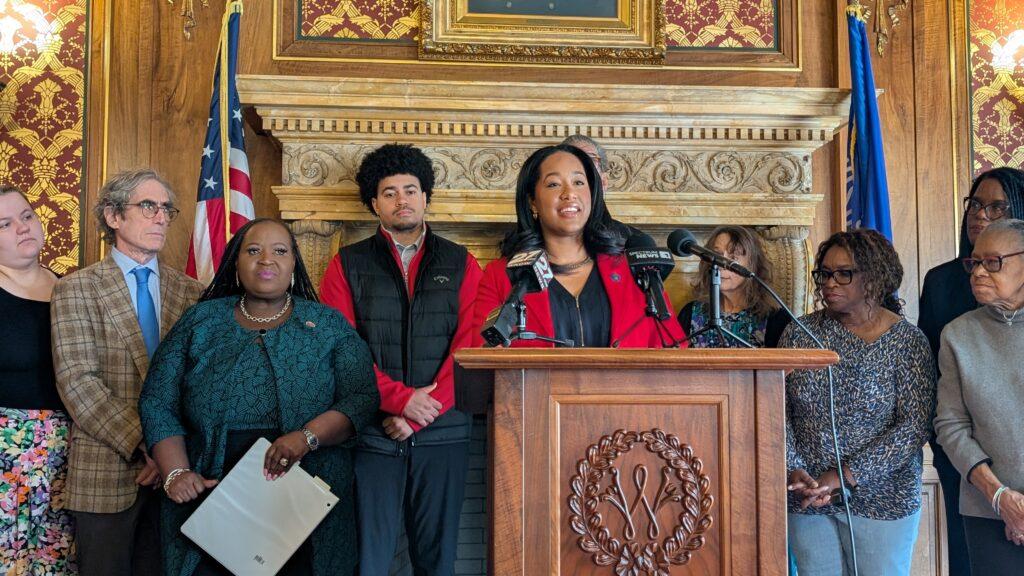


Each year, the caucus starts Black History Month with a celebration and ends it with a day of work by bringing community members together in the state Capitol for Black Advocacy Day to discuss the issues facing Black Wisconsinites, meet with Democratic and Republican legislators and network with other community members. The day was created by former Sen. Lena Taylor, who was a member of the caucus during her time in office and is now a Wisconsin circuit court judge in Milwaukee County.

Lawmakers developed their plans from listening sessions with Black Wisconsinites in four communities across the state.
Sen. Dora Drake (D-Milwaukee), who chairs the caucus, told reporters that the caucus’ policy agenda will serve as a guide in the future for drafting legislation.
“We know that the landscape is changing, and so we want to be proactive and make sure that we have a clear agenda of setting policy for next year,” Drake said.
Drake and Sen. LaTonya Johnson (D-Milwaukee), who sits on the Joint Finance Committee, said they believe Democrats will be able to win majorities in the state Legislature in this year’s midterm elections. Democrats are two seats away from control of the state Senate and five seats in the state Assembly.
“We can’t continue to not address these issues,” Johnson said, specifically noting Medicaid and providing resources to the Wisconsin public school system.
During a briefing, Johnson was joined by her fellow caucus members as well as Milwaukee County Executive David Crowley, who formerly served in the state Assembly and is currently running in the Democratic primary for governor, and Wisconsin Voices executive director and former state Rep. David Bowen.
The platform covered seven issue areas: improving affordable housing and protecting renters; education, literacy and economic opportunity; expanding access to affordable, comprehensive health and mental health care; ending mass incarceration and creating a rehabilitative criminal legal system; protecting people’s ability to participate in the democratic process; and helping communities by ensuring they have safe roads, clean air and affordable housing.
Johnson detailed some of the disparities that Black Wisconsinites face.
Housing
“Poverty hits Milwaukee the hardest, especially for Black Milwaukeeans,” Johnson said, adding, “30% of Black residents in Milwaukee live below the poverty line, which is the highest rate among major U.S. metropolitan areas. [Only] 27% of Black [people are] homeowners in Milwaukee, compared to the 56[%] for white households; $37,000 is the median household income for Black families in Milwaukee. That ranks us dead last among the 50 largest metropolitan areas. Poverty among Milwaukee’s African-American children is a whopping 38.8[%], which is the third worst out of the 50 largest metropolitan areas.”
Housing and protections for renters are at the top of the caucus’ agenda. Priorities include tenants’ rights and developing housing affordability programs for communities with high displacement risk, including a first time homebuyers program and a home repairs program.
Johanna Jimenez of the Community Development Alliance, a Milwaukee-based organization dedicated to increasing homeownership for Black and Latino residents, told the Examiner that the organization supports the goals of the Black caucus and sees a need to connect with lawmakers and other advocates.
“People there are struggling to become homeowners, to rent affordably and to live in safe housing,” Jimenez said. “Even though, like, we do housing every day, coming together on a larger scale and with more people, it’s super important. We recognize that not one person, not one organization, can get everything done, but we do have proof that when we come together, we get more done, and we get laws passed, people protected and more resources coming down.”
Jimenez said prioritizing renters and helping people become homeowners is important to building and stabilizing communities. She noted that out-of-state investors, who buy up property in Milwaukee communities, especially on the city’s North Side, driving up prices and limiting options for first-time homebuyers, continues to be an issue
“The tenants that are in our neighborhoods, they want to live in the neighborhoods, and so if we can focus on homeownership and putting resources aside for homeowners rather than giving investors an ‘easy way in,’ it would help communities… help families thrive.”
The caucus wants increase the state minimum wage, which currently sits at $7.25 an hour, expand access to job training in high-demand fields, including technology and skilled trades, provide targeted support for Black-owned small businesses and entrepreneurs, including grants and low-interest loans, and expand state investment in economic development in underserved communities.
Education
Johnson noted that the graduation rate for white students in Wisconsin is roughly 92.7% while the graduation rate for Black children is 71% — the largest gap in the country.
“Absenteeism is also a strong predictor of involvement with youth in the criminal justice system,” Johnson said, noting that data from the 2023-24 school year shows that Black students in Wisconsin have chronic absenteeism rates that hover around 47%, which is more than four times higher than the 11.2% absenteeism rate for white students.
Under its platform, the caucus says that it wants to work to “fully fund” public schools with targeted resources to bring up low literacy scores; expand evidence-based literacy programs, including early childhood and reading intervention initiatives; strengthen accountability and transparency in voucher schools and support development and recruitment of teachers and culturally responsive curricula.
It also wants to help protect people’s participation in the democratic processes by establishing a “Wisconsin John Lewis Voting Rights Act” that would ensure fair electoral maps and end gerrymandering, strengthen voting rights protections and expand civic education and community-led voter outreach.
Criminal justice reform
Johnson said the caucus also wants to end the cycle of mass incarceration. One attendee shook her head in agreement and said “amen” as Johnson spoke.
Some caucus priorities in that area include reforming sentencing guidelines, increasing community oversight of law enforcement practices, expanding reentry programs and ending crimeless revocations.
One proposal from the caucus meant to help improve the state’s criminal justice system, which was introduced this week, is a constitutional amendment proposal that would ensure Wisconsin bans slavery and involuntary servitude without exceptions.
Black history
When the Wisconsin Constitution was adopted in 1848, it included a prohibition of slavery and involuntary servitude. The state joined the union to ensure it followed the Northwest Ordinance of 1787, which forbade slavery in the territory, and to establish itself as a free state. However, that provision includes an exception for slavery or involuntary servitude if it is imposed as punishment for a crime.
Last week, the Republican-led Assembly refused to take up a resolution to recognize February as Black History Month, which wouldn’t have an effect on policy in the state but which lawmakers said represents a recognition of their history, achievements and work that has shaped the state.
During the Assembly floor session last week, Rep. Supreme Moore Omokunde (D-Milwaukee) said Republicans’ refusal to recognize Black History Month was “a horrific attempt to silence Black voices and to give us a subtle inference that our history isn’t as important as we think it is.”
Moore Omokunde noted that in the past Republicans have easily passed resolutions to honor President Ronald Reagan, Charlie Kirk and Rush Limbaugh — who Moore Omokunde noted called once called President Barack Obama a “magic negro.”
“At most, we should aspire to be one of the few Black faces in white spaces, and in order to be successful, we should strip ourselves of all of our identity and our traditions…This is only a glimpse of what it’s like to be a Black legislator in this building,” Moore Omokunde said. “You’re welcome to be here, as long as you have a signed permission slip.”
This year’s resolution sought to recognize Black people with ties to the state including Marcia Coggs, who was the first Black woman to be elected to the state Legislature and the first Black lawmaker to sit on the powerful Joint Finance Committee, Bob Mann, who was the first Black player to play a regular season game for the Green Bay Packers, and Malcolm X, who was a prominent Black Nationalist during the Civil Rights movement and had “unique ties” to Wisconsin.
Malcolm X’s family lived in Wisconsin while he was young after they fled Nebraska due to harassment from the Ku Klux Klan and moved to Milwaukee. His young brother, Reginald, was born in Wisconsin’s largest city. The family lived on West Galena Street on Milwaukee’s North Side until 1929 when they relocated to Lansing, Michigan.
Malcolm X returned to Wisconsin many times in the 1960s, visiting Milwaukee and speaking to local communities about racial injustice. His work inspired grassroots organizing in the state.
This year was not the first time that lawmakers have fought over proposals to recognize Black History Month. The state Assembly passed a resolution in 2025 honoring the month, but the resolution left out names of any individual people. The Senate passed that resolution in March 2025.
Whether or not Democrats do win control of the Senate and Assembly in November, Johnson and Drake expressed confidence that Republicans would not be able to continue to block their work on the issues in the same way that they have for many years.
“Even if we just get one house, we’re in a better position to hold them accountable,” Johnson said. “They’ll literally have to answer for why these things aren’t good ideas, or why this isn’t good governance when they see the numbers that we’re dealing with.”