





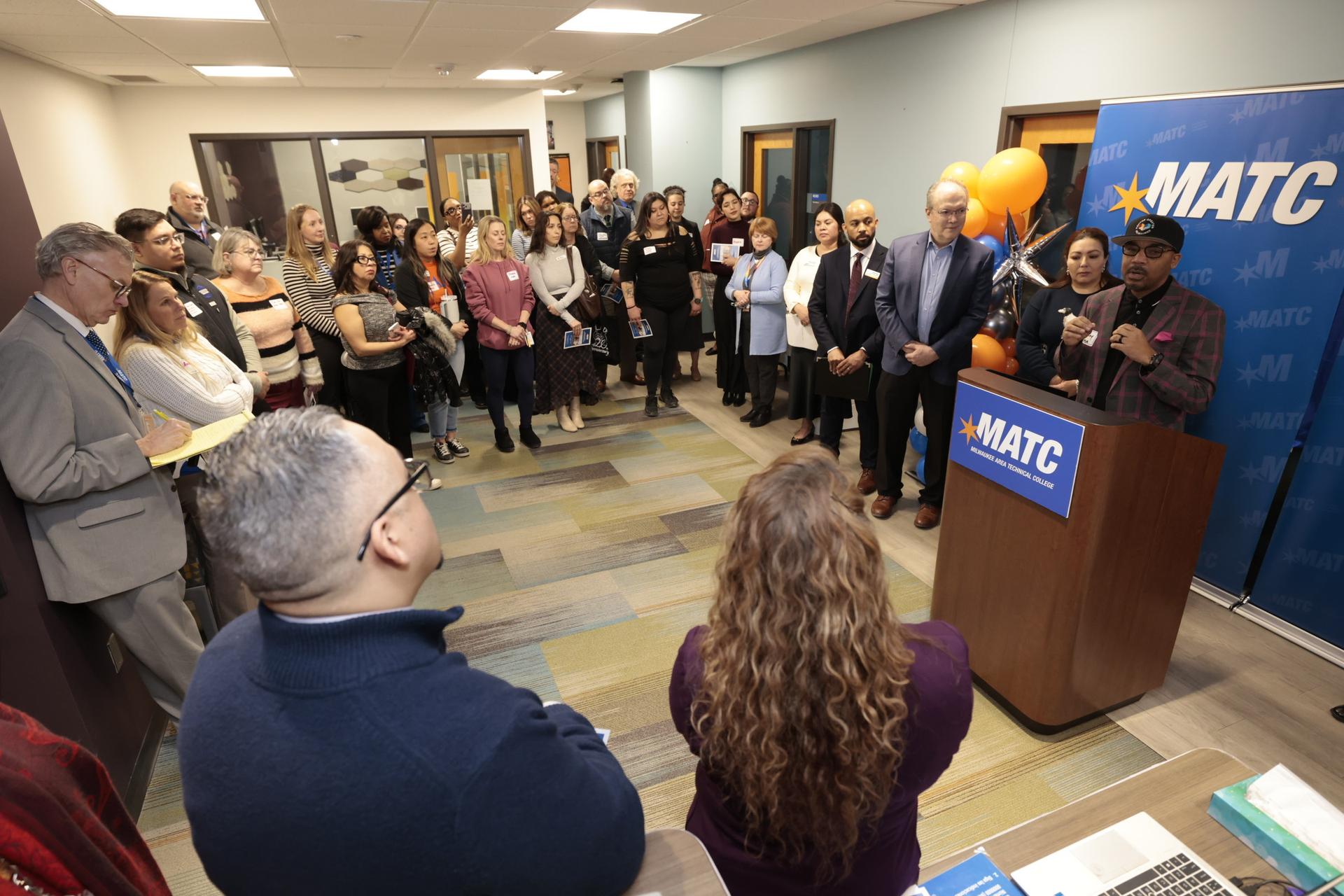
Source: Photo provided by MATC
MATC’s Office of Community Impact is now open. What does it do?
Feb 13, 2026, 3:14 AM CT


Share
Originally published by Milwaukee Neighborhood News Service.
Milwaukee Area Technical College students can connect with peer mentors and access leadership development opportunities through the new Office of Community Impact, say its leaders.
MATC Vice President of Student Engagement and Community Impact Michael Rogers said the office was created to support student success.
“Our overall belief is that as we work to support our students at MATC and then these students move on to graduation, that this is then in turn going to improve the Milwaukee community,” he said.
MATC President Anthony Cruz said students come to the school with varied life experiences, from working parents, to veterans, to first-generation college students.
“The Office of Community Impact supports their journey by recognizing these differences, removing barriers that may result from these differences and designing pathways to reach their education and career goals,” said Cruz in a statement.
From student to student mentor
Peer mentor and MATC student Soukaina Haddad wishes she had extra help when she started school.
“I made a lot of mistakes and was wasting a lot of energy running between offices to find the right resource or the right person who could help me,” Haddad said. “I was simply not aware of the resources that MATC offers.”
Now, Haddad is one of three students who are part of the Office of Community Impact’s new peer mentorship program. Rogers said the mentors have spent at least a year at MATC and are in good academic standing with the college.
“Our mission as peer mentors is to help other students to navigate college life, making sure that they are having smooth transitions and a productive experience at MATC,” Haddad said.
Rogers said students usually connect better with their peers.
“When students connect with other students, they’re more likely to be kind of open about the challenges that they’re facing, as opposed to meeting with the staff members,” Rogers said.
Rebecca Arcos-Piedra, Office of Community Impact manager, said the office can hire up to seven students as mentors with its current budget.
Partnerships with other organizations
The program includes a partnership with MENTOR Greater Milwaukee, an organization that advocates for quality mentoring in the Milwaukee metropolitan area.
The office will provide professional development opportunities to help faculty and staff develop a mentoring mindset.
“There will be different training opportunities for our faculty and staff to really equip them with the skills to work with our student population,” Rogers said.
Partnerships are also being established with United Community Center, African American Leadership Alliance of Milwaukee, Chabad on Campus of Milwaukee and the Ho-Chunk Nation Milwaukee Branch Office.
Angela Adams, president and CEO of the African American Leadership Alliance of Milwaukee, said her organization’s goal is to develop and support diverse and talented leaders and is engaging with partners like MATC to achieve these goals.
“The African American Leadership Alliance Milwaukee (AALAM) is inspired by MATC’s commitment to expanding opportunities and experiences for students, faculty, and the community through their Office of Community Impact.”
Community space

MATC freshman and Office of Student Life employee Cameron Gunder stumbled across the office while walking around campus recently. She said she likes that students can learn more about the resources at MATC there and would like to see the office promoted across campus.
“A lot of people aren’t going to even know this is right here,” she said.
Gunder said the office has good potential to be a community space for students.
“I’m just hoping this will be a place where it’s safe,” Gunder said.
Mary Greuel, a co-lead with the LGBTQ+ employee affinity group Pride Alliance, said the Office of Community Impact will help lead “safe zone” training for faculty, which the college currently outsources.
Asian Affinity Group co-lead Christine Leung said the office will also collaborate with their group, which provides a safe space for all Asian and Pacific Islander employees. The Asian Affinity Group will work with the office to coordinate events and resources for employees and students.
Concerns about former Office of Multicultural Services remain

The Office of Community Impact developed out of MATC’s former Office of Multicultural Services, which the college phased out in August. Four student service specialist positions were eliminated when it closed.
A Nov. 19 media statement from MATC said two of the four affected employees are still working at the college in ongoing or new capacities.
Carlos Aranda is a counselor at MATC and member of the Coalition to ‘Restore the Four,’ which grew out of concern about the decision to rebrand the department and eliminate the four service specialists.
The coalition, composed of educators, advocates, community-based organizations and allies, is concerned that the office’s rebranding shifts away from accountability and toward optics. Aranda said it also masks the elimination of experienced leadership.
He said the coalition has issued written correspondence to the college board of directors and president, participated in public forms and engaged in coordinated advocacy efforts.
“Despite these efforts, MATC leadership has failed to engage meaningfully, which has intensified community distrust,” Aranda said.
Rogers said the college will continue to offer some resources previously offered in the Office of Multicultural Services, including computer lab access. Food assistance has transferred to the Student Resource Center.
He said the new office will build off support previously offered by the Office of Multicultural Services by including the new peer mentoring, leadership development and community partnerships.
“We’re just continuing to really strengthen what that support looks like,” Rogers said. “It’s really just taking an opportunity to build upon those things so that we can really expand the support that we provide to all of our students.”

Alex Klaus is the education solutions reporter for the Milwaukee Neighborhood News Service and a corps member of Report for America, a national service program that places journalists in local newsrooms to report on under-covered issues and communities. Report for America plays no role in editorial decisions in the NNS newsroom.
Want More Local News?

Civic Media
Civic Media Inc.
The Civic Media App
Put us in your pocket.