
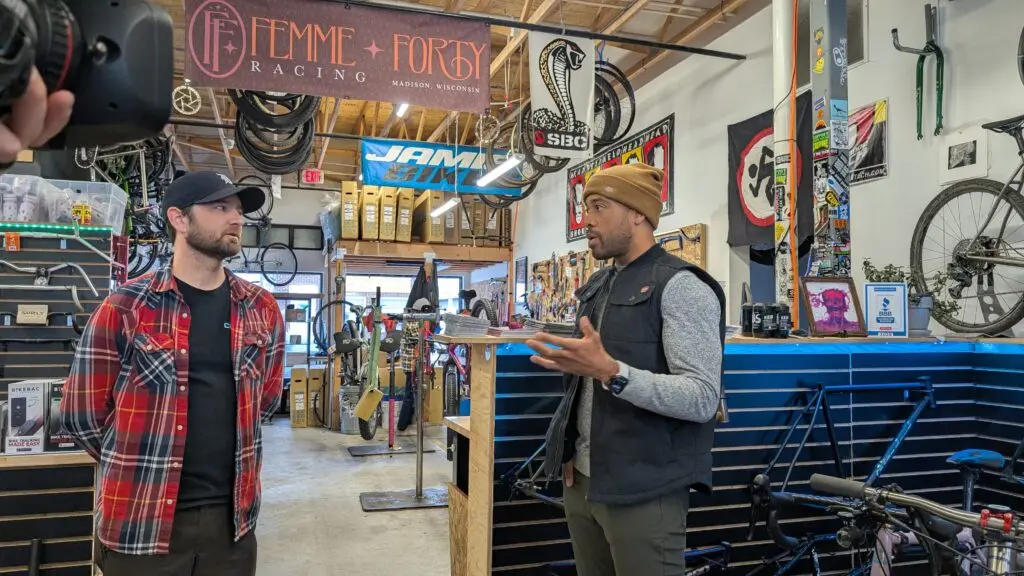


At a forum hosted by the Madison West High School civics club, former Lt. Gov. Mandela Barnes told students that he would be the strongest Democratic candidate for governor because of his previous statewide experience.
“This will be an incredibly competitive race. It already is. The general election is going to show up fast and furious,” Barnes said in April. “I am the only person who has ever competed at that level.”
Barnes was referring to his 2022 U.S. Senate race, which he lost to Sen. Ron Johnson by about one percentage point. Barnes is now seeking Wisconsin’s top executive office and arguing that nearly winning that Senate seat combined with his statewide experience has uniquely prepared him to take on U.S. Rep. Tom Tiffany, Republican candidate for governor endorsed by President Donald Trump.
Barnes entered the race in December and he’ll need to get through a crowded Democratic primary to make it onto the November ballot. It’s unlikely the rest of the Democratic candidates will drop out to clear the field for him as they did in the 2022 Senate race. Other Democratic candidates on the ballot include state Rep. Francesca Hong (D-Madison), Lt. Gov. Sara Rodriguez, Milwaukee County Executive David Crowley, former Wisconsin Economic Development Corp. CEO Missy Hughes, former head of Gov. Tony Evers’ Department of Administration Joel Brennan and State Sen. Kelda Roys.
Putting in the work
Barnes, 39, grew up in Milwaukee the child of a public school teacher and an auto worker who was a member of United Auto Workers (UAW) union and worked third shift for decades. He first ran for office at 25, winning a seat in the state Assembly. He served two terms in the Legislature before launching a failed campaign for the state Senate.
“I felt that there weren’t enough people who understood what it meant to be born in our state’s poorest and nation’s most incarcerated ZIP code,” Barnes said of his motivation for seeking political office. He came back in 2018 to run for lieutenant governor, winning a spot on the ticket with Gov. Tony Evers in 2018. He served as the state’s first Black lieutenant governor before he challenged incumbent U.S. Sen. Ron Johnson.
Barnes, an avid runner and biker, told the Examiner in an interview that politics is an “endurance sport” and that “sometimes you face setbacks” — adding that he faced setbacks every day in the Assembly and views his loss to Johnson as another setback. There is too much on the line, however, to give up and stop working toward his goals, he said.
“In order for us to truly make Wisconsin the place that it can and should be — not just to catch up to our Midwest neighbors, but to lead this entire country in terms of progress — I have put in that work. I have put in that fight, and there’s nobody who’s put in their work in the advocacy space,” more than he has, Barnes said. “I see becoming governor as the best opportunity to continue that focus, to continue that work.”
Barnes has made it his campaign motto that he will do things the “Wisconsin Way” instead of the “Washington Way.” He criticizes Trump and his ally Tiffany as being “out of control.”
The Barnes campaign is focused on the rising cost of living for Wisconsin families.
“There is an affordability crisis that affects almost every household in this state, whether it’s healthcare, whether it’s groceries, whether it’s energy bills, or whether it’s housing, and it feels like there’s no sign of things letting up,” Barnes said. He added that voters are looking for leaders who understand those pressures firsthand.
Barnes spoke with the Examiner about two weeks after the failure of a bill negotiated by Wisconsin’s soon-to-retire Democratic governor and Republican legislative leaders who are also about to leave office that would have spent down the state’s $2.5 billion projected budget surplus to provide tax cuts to Wisconsinites and additional special education funding to schools. He expressed opposition to the deal, which most legislative Democrats along with a handful of Republicans rejected. He said policymakers need to “be more deliberate about negotiating big tasks.”
An organizer’s mindset
Over the last three years, Barnes has led Power to the Polls Wisconsin, a grassroots voting rights organization dedicated to mobilizing voters, combating voter suppression and advocating for underserved communities of color and working-class families. He also founded Forward Together Wisconsin, a clean energy nonprofit. He brings an organizing mindset to the legislative process.
“People shouldn’t feel like they’re rushed to get legislation passed… I think that there should be more public hearings,” he said, adding, “There’s not a whole lot of public input.”
Barnes said the projected surplus “didn’t just come out of nowhere; it’s because Republicans have withheld investments in our future.” He, like the Democrats who are hoping to win control of at least one chamber of the Legislature in the fall, would like the opportunity to reverse years of Republican budget policy without facing a looming budget deficit, which analysts predicted would result from the tax-cut and school funding deal.
“The answer to most of our problems is simple,” Barnes said. “It’s just a tax on billionaires, tax the wealthiest, tax large corporations that have every tax advantage at their disposal.”
“Ultimately, if a state like Wisconsin is a place that fully funds our schools, puts more support into higher education, tech schools, and university system, invests in public transportation,” he added, “that’s how you make the state a much more attractive place.”
Closing tax loopholes
Barnes said he would focus on closing tax loopholes that allow large corporations and wealthy individuals to reduce their tax burden. One example is Wisconsin’s manufacturing and agriculture tax credit, which provides a credit of 7.5% on income from eligible qualified production activities — reducing the effective corporate tax rate on qualifying income from 7.9% to about 0.4%.
Barnes wants to change it so “it benefits our family farmers, not these factory farms, corporate farms” and the “primary benefit also goes to Wisconsin very small businesses versus out-of-state corporations.”
He said he would not seek to raise income taxes on families making $400,000 or less, but those making more should pay more. He didn’t offer specifics, but said that the income tax brackets could change, mentioning Minnesota as an example. Wisconsin’s neighbor’s top income tax rate is currently 9.85%, while Wisconsin’s is 7.65%.
“I’m not saying we’re taxing people into poverty, right? That’s not the case. We’re not taxing people out of the state,” Barnes said. “We’re just looking for a little bit of parity.”
Barnes said that Wisconsin “shouldn’t be left behind anymore.”
Barnes has said he supports increasing state funding so it covers two-thirds of public school costs and has called for repealing Act 10 to restore collective bargaining rights for public employees, including teachers. He also backs increased investment in the University of Wisconsin system and technical colleges, though he has not outlined a specific number.
Barnes, if elected, will need to win support in the Legislature to advance his agenda. He said he is optimistic about Democrats’ chances of winning the majority, but he would be open to negotiating with anyone should he win office.
“I’m willing to play ball,” Barnes said, though that negotiation commitment would not extend to one of his top promises — Medicaid expansion. He has promised to veto any budget that doesn’t include it, even as candidates have argued over whether an expansion would be the best way to address costs in light of federal changes made by the Trump administration.
Barnes said an ultimatum would not inhibit his ability to negotiate with lawmakers because the issue shouldn’t be partisan.
“It is a politicized issue,” Barnes said, noting that Republican-led states including Louisiana have taken the expansion.
Republican lawmakers who hold the majority in the Legislature, have refused to expand Medicaid since 2010. Barnes said during the student forum that he finds it “very hard” to find common ground with Republicans because the party has become “essentially the Republican party of one person” and he doesn’t want to find himself “in a place where I am validating bad behavior.”
Making a comeback
Barnes argues that his gubernatorial candidacy has the support he needs to win, although there was some public skepticism even before he entered the race. He was the subject of a New York Times article comparing his loss to Johnson in 2022 to former Vice President Kamala Harris’ loss in 2024. The Milwaukee Courier, a prominent Black-owned newspaper, urged him in an opinion piece not to enter the race.
Barnes said of the criticism that people have “gotta have something to write about.” Asked whether he needed to build back trust with Wisconsin Democrats ahead of running statewide again, he said he didn’t think it was about that.
“People know how much money was spent against me. People know that I was the most targeted Democrat in the entire country, the target of the largest anti-Democratic candidate super PAC in the country. People know what I was up against and the relationships I built over the course of that race. People know that I was counted out from the very beginning,” Barnes said. “People know how Republican billionaires are willing to spend big, and this is a moment for us to fight back against those corporate interests that have held Wisconsin back, and they’re ready to see this through.”
Barnes’ campaign finance report from December included a mix of donations from Wisconsin-based donors, including those who live in Milwaukee and Madison as well other towns and cities across the state, and many from other states including California, Colorado, Illinois, Massachusetts, New York and Virginia as well as Washington D.C. Barnes also received a donation from the Long Run PAC, a group he launched to support progressive candidates. He has a goal to raise $50 million over the course of the campaign.
In the first half of the year, Barnes has also received a mix of endorsements from Wisconsin Democrats, including State Reps. Angelina Cruz and Amaad Rivera-Wagner and Green Bay Mayor Eric Genrich and from national political players including California Sen. Adam Schiff, and most recently, the Natural Resources Defense Council Action Fund, a leading environmental advocacy organization.
Climate change and utility costs
“No one in Wisconsin has done or will do more to tackle the climate crisis while lowering costs for working families than Mandela Barnes,” Jed Ober, managing director of Natural Resources Defense Council Action Fund, said in a statement.
Barnes has made reducing utility rates one of the key parts of his affordability platform. He says that he’ll seek to freeze rates as governor by appointing commissioners to the Public Service Commission, which regulates utilities and approves rates, who will do so. Utility experts have criticized the plan and said its unclear whether he could carry it out, though Barnes said that criticisms of that plan are being levied by “the industry itself.”
Barnes has said he would appoint commissioners who have a “demonstrated commitment” through a “thorough interview process” and they will need to have worked alongside the industry and have a “real deep understanding of how we can actually benefit the public to make sure that the PSC is doing its job to represent the public interest.” He added that he would like to increase staffing at the PSC as well.
Barnes said environmental policy will be a priority. He chaired a climate change task force as lieutenant governor that he noted produced a slate of policy solutions that were later introduced by Democratic lawmakers as a package of 18 bills.
The Senate race as well as his time serving as the state’s second-in-command helped him enter the race with the most name recognition, according to polling by Marquette Law School. On the other hand, Charles Franklin, the Marquette Law School poll director, looked at the track record of five statewide candidates, Republican and Democrat, who lost an election and ran again for statewide office. He found that name identification and previous campaign experience, including established donors, did not significantly improve the percentage of votes they got in the general election in their second statewide campaign. The last successful “second act” was the 1970s, he said.
Barnes is working to convince enough voters that he can overcome the historical pattern and is the best candidate to compete in November. He is reaching people in a variety of ways, including traveling the state to attend forums and county Democratic Party meetings, where he said he’s been glad to reconnect with people across the state whom he hasn’t seen in a while.
Through his @MandelaHQ account on X, Barnes has adopted a rapid-response social media style reminiscent of national campaign-style accounts like @KamalaHQ during the 2024 cycle. The account highlights poll results, including a recent one that showed Barnes winning in a matchup against Tiffany, targets Tiffany with humor and memes — one post featuring Tiffany at a farm joked that “cows can smell DC stink” — while also promoting policy proposals through short videos. In one video on banning AI-driven dynamic pricing and hidden fees, a group of children raise the price of lemonade after Barnes passes by on a run.
Barnes told students that one of the biggest misconceptions about him is that he doesn’t “get to be as funny” as he’d like.
“It’s tough because in politics, if you crack a joke or people aren’t able to translate sarcasm, like the story’s getting written the wrong way,” Barnes said. “I can’t be as funny as I want to be… sometimes my humor is a little dry. It’s not for everybody.”
Editor’s note: The Examiner is running periodic profiles of the contenders in the Aug. 11, 2026 gubernatorial primary as well as the candidates in the general election Nov. 3.