

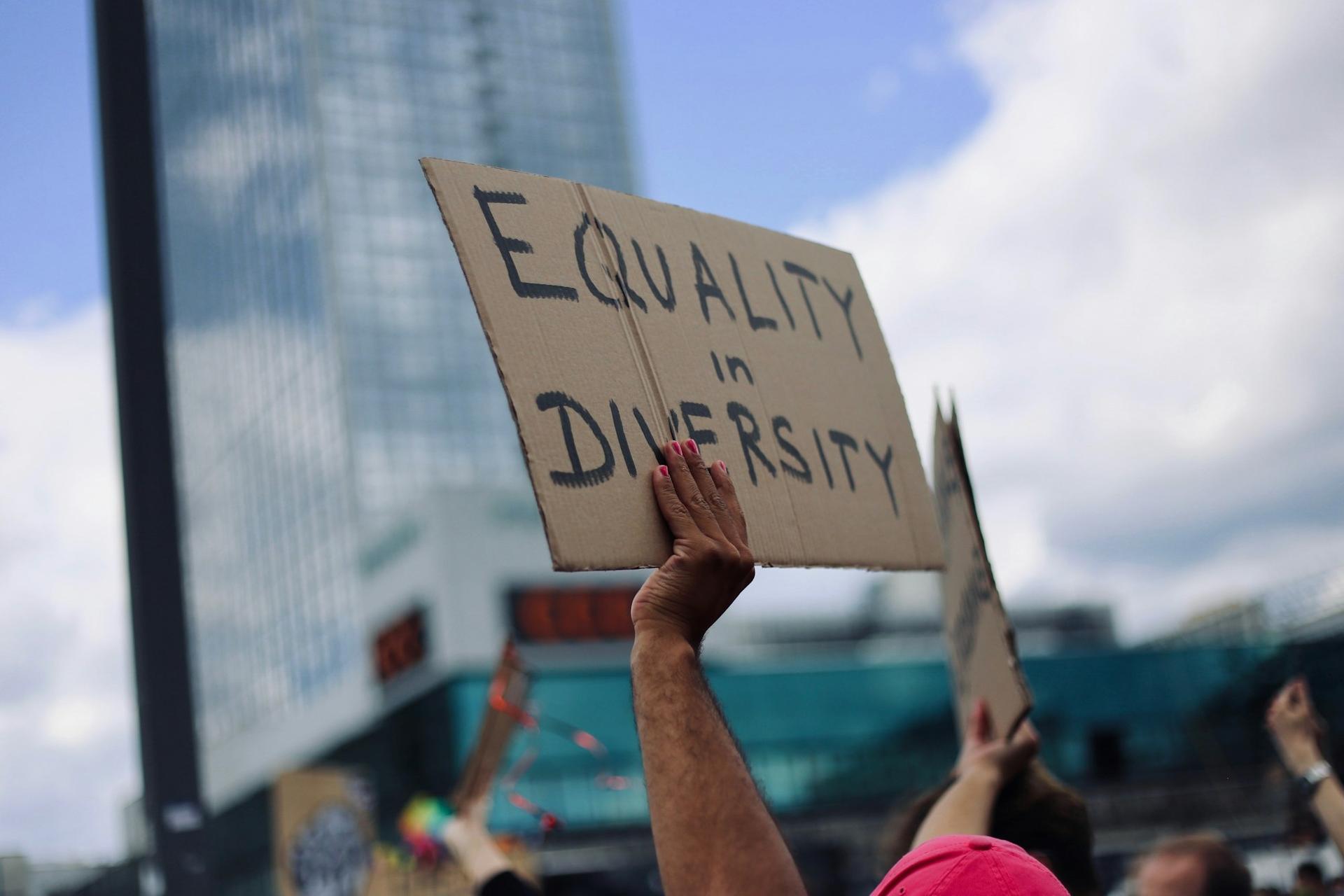


Joan Schwartz, who sits on the Legislative Advocacy Committee of the League of Women Voters of Wisconsin, warns that the latest in a long slate of Republican constitutional amendments is so vague that it might fool voters and leave the terms of the amendment uncertain enough that it could undo decades of affirmative action policy.
The amendment, one of three on the November ballot, is headlined ‘Governmental entity discrimination prohibited,’ and would, in the amendment’s language, prohibit governmental entities in the state from discriminating against, or granting preferential treatment to, any individual or group on the basis of race, sex, color, ethnicity, or national origin in public employment, public education, public contracting, or public administration.
Voters who read only the first sentence may not realize the far-reaching implications of the amendment. The federal government already prohibits discrimination by any state or government, but this amendment goes much deeper.
Schwartz’s concern is that its application could be interpreted so broadly it could include municipalities, the UW system, the technical college system, any public college or university, and any public school district. It also would include any government office, department, independent agency, board, commission, authority, institution, association, society or other body in state or local government, including the legislature and the courts. Businesses under contract with the government would also be included.
“They (also) don’t define ‘preferential treatment,’” she pointed out. “We, as voters, won’t be given a definition of that. That means any equity-based programs, DEI, affirmative action, anything that exists in Wisconsin and has for 50 years, is going to be unconstitutional.”
The amendment would also make unconstitutional Gov. Tony Evers’ executive order that created the Governor’s Advisory Council on Equity and Inclusion and could reverse such things as health disparity programs, partnerships and grants that serve disadvantaged minority populations, and Black maternal health programs, among others.
State Sen. Dora Drake (D-Milwaukee) called the amendment dangerous. She cited as an example the state’s Supplier Diversity Program, which has been around since the 1980s and supports minority-owned, women-owned, and “Service-Disabled Veteran-Owned” businesses, which could be deemed unconstitutional under this amendment.
Republicans have tried to use constitutional amendments repeatedly during Evers’ term after becoming frustrated at his vetoes.
There are other implications regarding the amendment and the widespread impact it might have: Would accelerated or remedial classes or English-learner assistance for K-12 students remain constitutional? Would UW-Madison grants supporting minority students still be allowed? Would classes built around ethnic or gender issues be deemed unconstitutional. Might history and social studies curriculum have to be rewritten?
The League of Women Voters of Wisconsin and the American Civil Liberties Union of Wisconsin testified against the amendment, arguing that policies and regulations are not intended to be enshrined in the Constitution but should go through the regular legislative process.
The Wisconsin Institute of Law and Liberty (WILL) testified in favor of “The Equality Amendment.”
Additional amendments proposed
The Legislature proposed a second Constitutional amendment that would prohibit state and local governments from ordering places of worship to close during a state of emergency, including a public health emergency. This amendment was motivated by emergency orders issued by Evers during the COVID-19 pandemic that restricted public gatherings, including religious services.
A third proposed amendment would prevent the governor from using Wisconsin’s partial veto power to extend or create a tax or fee. Currently, the governor is allowed to strike entire words, numbers, and punctuation in appropriation-bill text. In 2023, Evers’ used such a partial veto to extend a two-year increase in school revenue to a 400-year increase, angering Republicans.
To amend the Constitution, both houses of the Legislature must approve identical language in two consecutive legislative sessions. After that, the amendment is scheduled for an election, where it will be on every Wisconsin voter’s ballot. Since the state’s founding in 1848, there have been approximately 200 proposed amendments to the Constitution, 151 of which have been ratified.
Wisconsin voters cannot currently put referenda or Constitutional amendments on the ballot.
A vote NO campaign is being planned by many of the state’s pro-democracy groups, including the League of Women Voters of Wisconsin.