





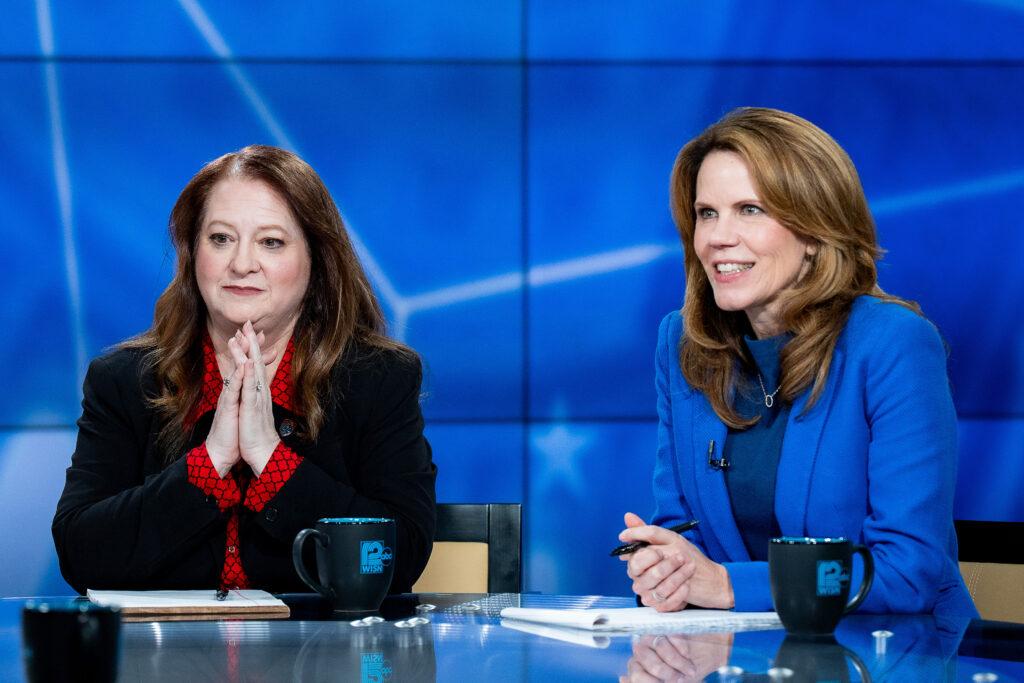


Wisconsin Supreme Court candidates Maria Lazar and Chris Taylor tried to tag each other with accusations of partisanship during the sole debate in the campaign Thursday evening.
After the initially scheduled debate last week was canceled because Taylor was hospitalized with a kidney stone — and another delay Thursday due to severe weather in the Milwaukee area — the debate, moderated by WISN’s Matt Smith and Gerron Jordan, was held at WISN’s studio in Milwaukee just five days before polls open April 7.
The candidates are vying for an open seat on the Court being vacated by conservative Justice Rebecca Bradley. After a string of high stakes races for the Court because the ideological swing of the body was up for grabs, this year’s race has drawn less attention and less money. This year the race will decide if the Court’s liberal wing will gain a 5-2 majority or if the split will remain 4-3.
Through most of the campaign, Taylor has led in the polls and raised more money, however recent polling showed large swaths of the state’s voters remained undecided.
Taylor, a judge on the state’s District IV Court of Appeals who previously worked on the Dane County Circuit Court, as a Democrat in the state Assembly and as the policy director of Planned Parenthood of Wisconsin, painted herself as a “scrupulous” judge who is proud of her work in the Legislature but will bring an independent judicial record to the Supreme Court.
“I am scrupulous in applying the law, and I have a spine of steel when it comes to making sure people’s rights and freedoms are protected,” Taylor said.
Lazar, a judge on the state’s District II Court of Appeals who worked on the Waukesha County Circuit Court and as an assistant attorney general at the Department of Justice under Republican Attorney General J.B. Van Hollen, touted her longer tenure as a judge and described herself as an independent jurist who has never belonged to a political party.
“I guess when my opponent has a few more years of judicial experience, she’ll understand that being reversed is a part of being an independent judiciary,” Lazar said.
Yet, as has been the case throughout the campaign, the candidates each tried to cast their opponent as a partisan extremist.
Lazar repeatedly said that Taylor was answering questions as a legislator, not a judge.
“On the one hand, you have a judge, an experienced judge who has been on the bench for more than 12 years, protecting the rights of everyone in the state,” Lazar said. “And on the other hand, you have a radical, extreme legislator who is known as the most liberal of the 99 in that Assembly, who now as a judicial activist, wants to put her views, her values and her agenda in the court above the law.”
But Taylor pointed to cases in which Lazar sided with right-wing interest groups, endorsements from right-wing figures and her work before joining the bench to argue that Lazar is the more partisan figure.
“She has a very specific agenda that favors big corporations and right-wing special interests,” Taylor said.
The first clash of the night came over the state’s political maps and election law. Through much of the campaign, Taylor and her supporters have argued that if Lazar is elected she’ll be a vote on the Supreme Court in favor of potential Republican efforts to meddle with the state’s election results.
Taylor pointed to Lazar’s previous support from election conspiracy theory figures such as Michael Gableman and her decision in Wisconsin Voter Alliance v. Secord, in which Lazar was criticized by the Supreme Court for ignoring existing precedent to rule that a group of election deniers should be given access to the confidential voting records of people with disabilities. She said that Lazar would be a “rubber stamp” for federal efforts to interfere in the state.
In response, Lazar defended the state’s election system more forcefully than she had previously on the campaign trail.
“I think it’s important that we tell people in the state of Wisconsin that our elections are safe, they’re fair and that their votes count, and that’s the key, important thing that we need to address in this state,” she said.
The sharpest disagreement of the night came during a discussion of abortion. Last year, the Court struck down the state’s 1849 criminal abortion ban, which had halted abortion services in the state following the U.S. Supreme Court’s decision to overturn Roe v. Wade. Since the state Court’s decision, a previously instituted law banning abortion after 20 weeks has been the guiding law in the state.
Lazar said that she thought the return of abortion policy decisions to the individual states was a good thing and that she believes the 20 week line is a good compromise for the divided Wisconsin electorate.
“I think that it falls within the parameters of where people in the state believe it should be, and if they don’t, the answer is to go to the legislature and the governor, not the courts,” she said, accusing Taylor of supporting abortions up to birth.
Taylor said Lazar’s support of overturning Roe v. Wade ignores the women across the country who have been harmed by losing access to abortion care.
“So it is tragic that we have someone running for the state Supreme Court that is celebrating that there are women all over this country who are victims of rape and incest … losing access,” Taylor said. “That is what the reality of overturning Roe v. Wade, that you have called very wise. It’s not been very wise for victims of rape and incest who now live in states where abortion has been outlawed. It’s not very wise for women who have lost their lives in states because they couldn’t get help when a pregnancy went wrong.”
Lazar responded by again accusing Taylor of acting as a partisan.
“This is exactly what we’ve been doing in this campaign,” she said. “It’s the same old political playbook. If you don’t have anything truthful to say about your opponent, then just lie and mislead.”
Early voting is open until Saturday. Polls open at 7 a.m. on Election Day, April 7. Details for poll locations and hours can be found at MyVote.WI.gov.