





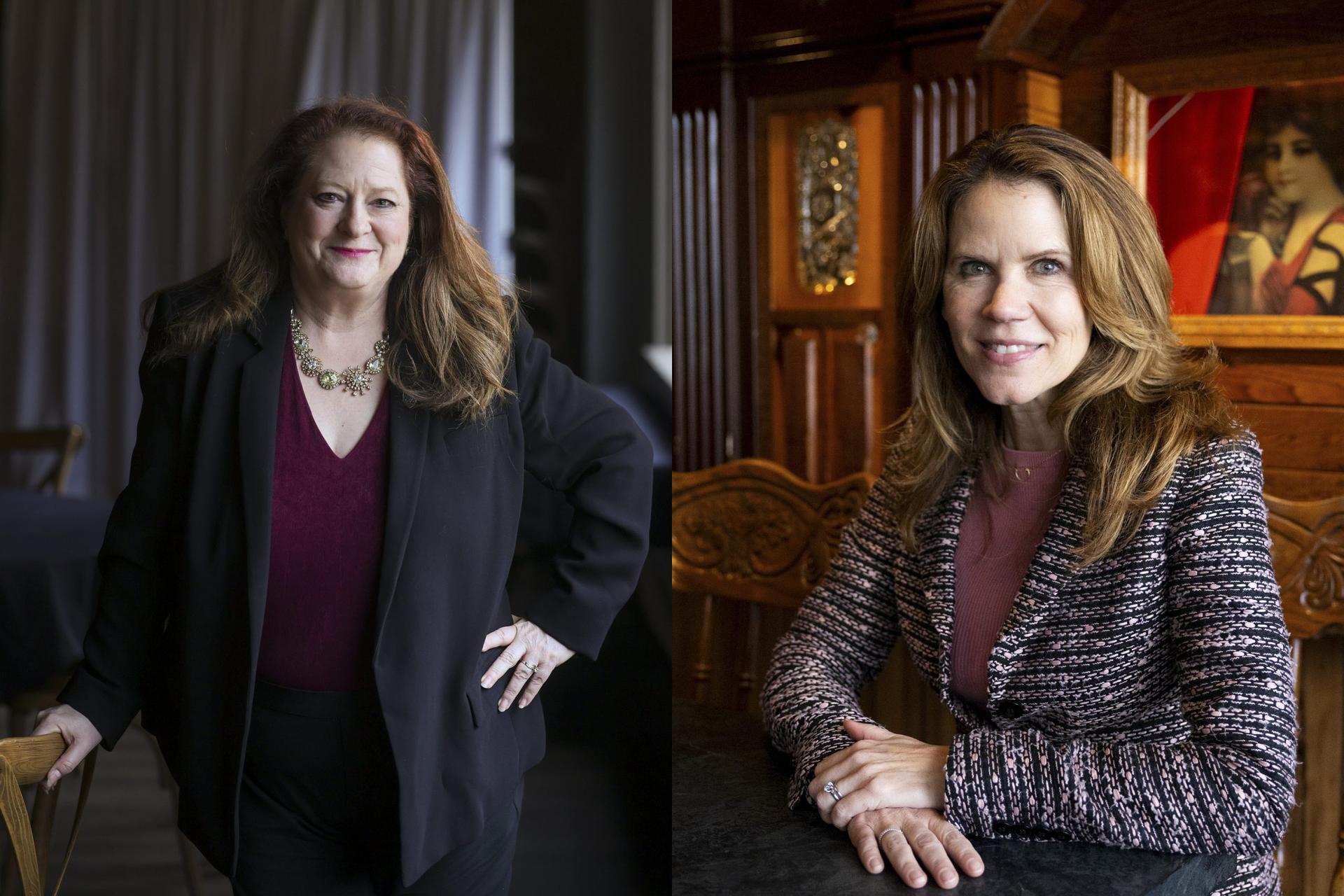


Inside a dimly lit banquet hall at an Irish pub in Germantown and at a century-old supper club along Wautoma’s Silver Lake, both 2026 Wisconsin Supreme Court candidates championed a fair and impartial judiciary.
“We need to put someone on this bench who is not going to cater to the public whims, who is not going to put their hand up in the air and say, ‘What trend in society is important today?’” one candidate told the Germantown crowd.
“We must have the judiciary be fiercely independent,” the other candidate said in Wautoma. “We cannot be rubber stamps for any party, any branch of government and certainly not the federal government.”
A voter might have trouble deciphering which candidate made which statement, but in the April 7 election to fill an open seat on the state’s high court, the choice couldn’t be more stark.

While both Appeals Court judges Maria Lazar (the candidate in Germantown) and Chris Taylor (the candidate in Wautoma) advocate for impartiality, their judicial philosophies and public support represent opposing political views on issues such as reproductive health care, criminal justice policy and the balance of power between government and business. Taylor is a former Democratic lawmaker. Lazar is a member of and has spoken three times before the conservative Federalist Society. Taylor is endorsed by the Democratic Party of Wisconsin and Democratic U.S. Sen. Tammy Baldwin. Lazar is endorsed by former Republican Gov. Scott Walker and the state’s six Republican members of Congress.
The election marks a quiet departure from the two most recent high court elections when it comes to national attention, spending and vicious political attack ads. As of mid-March, outside spending by political groups on the 2026 election reached just over $638,000, according to the Wisconsin Democracy Campaign, which tracks money in state elections — far below the nearly $25 million at this time last year.
“It’s a positive in that it’s a much more low-key, low-energy, civil election,” said Howard Schweber, a professor emeritus of political science and legal studies at the University of Wisconsin-Madison. “You can argue that it has gone too far. There has to be something in between the endless barrages of television advertisements and elections that happen without anybody knowing about them, and as a state we do seem to, with respect to judicial elections, have trouble finding that happy middle ground.”
With fewer fireworks in 2026, the race has instead highlighted the stark contrast between Lazar and Taylor’s political backgrounds and how their campaigns have used those differences to attack each other.
Lazar, a conservative member of the Waukesha-based 2nd District Court of Appeals, started her legal career in private practice before joining the Department of Justice as an assistant attorney general under Republican Attorney General JB Van Hollen. During that time, she defended Gov. Scott Walker-era laws, such as voter ID and Act 10. She was elected to the Waukesha County Circuit Court in 2015 and 2021 and then to the Court of Appeals in 2022 when she unseated an Evers-appointed judge. That race also broke along party lines, with Republicans supporting Lazar.
Taylor, a liberal member of the Madison-based 4th District Court of Appeals, also began in private practice. Taylor worked as a policy and political director for Planned Parenthood of Wisconsin for eight years until winning an Assembly special election in 2011 as a Democrat. Gov. Tony Evers appointed Taylor to the Dane County Circuit Court in 2020, and she ran unopposed in the 2023 election for the Court of Appeals.
Taylor’s campaign and liberal-leaning groups have seized on Lazar’s resume, often describing her as an extremist. Lazar’s campaign has swiped at Taylor’s legislative experience, casting her as a radical politician.
In interviews with Wisconsin Watch, both candidates dismissed the partisan labels.
“I’m not a Republican,” Lazar said. “No, I didn’t work for Scott Walker. I represented Scott Walker. I represented legislators. I represented the Government Accountability Board. I represented Tony Evers and Doug La Follette. So anyone who thinks that I’m extreme because I actually tried to do a good job and represent my state is the extreme party.”

Taylor, who told Isthmus earlier this year that she is a Democrat, said she does not approach her judicial work from a liberal viewpoint.
“I don’t ever think of myself as the liberal,” Taylor said. “I hear it all the time. I know everyone says that, but I don’t approach being a judge that way at all.”
The stakes in 2026 are different
The election’s subdued tone stems largely from the fact that no court majority is on the line.
Lazar and Taylor are running for the seat being vacated by conservative Justice Rebecca Bradley, meaning a Lazar wins on April 7 would not shift the court’s ideological balance. The liberal majority could grow to five out of seven seats with a Taylor victory, guaranteeing liberal control of the court through at least 2030.
“That would make the road back to a conservative majority very difficult, indeed,” Schweber said.
In addition, conservative Justice Annette Ziegler earlier this month announced she would not seek reelection in 2027. That could open the door further for liberal candidates, who in 2023 and 2025 won by more than 10 percentage points.

When Lazar discusses what’s on the line in this race, she tells supporters that the liberal majority on the court cannot “ever” grow to five justices. Three justices must agree to hear an appeal. The court needs balance — and to reflect the people of Wisconsin, Lazar explained to supporters in Germantown.
“We need to make sure that we have someone up there who can vote to take appeals,” Lazar said. “We need to make sure we have someone up there who will not legislate from that bench.”
Waukesha County Judge K. Scott Wagner said Lazar possesses the temperament, intellect and respect for the law the Wisconsin Supreme Court needs at this time. The two first met as private practice attorneys on a commercial litigation case in 1989. She encouraged Wagner to run for judge last year, he said.
“She really is very common sense. She understands the role of the court,” Wagner said in an interview. “I don’t think people understand how the courts are supposed to work. They really are the nonpartisan referee, and even in my brief career on the bench, I’ve had to say, ‘Look, this is not a law I would have written, but it’s a law that exists, so I’m going to apply it.’ You’re like the ref. I think she gets that.”
At recent campaign stops in central Wisconsin, Taylor describes the race as a chance to expand a “pro-democracy” majority on the Wisconsin Supreme Court. A strong court can protect the state from future attacks on the elections, she told the room in Wautoma, highlighting the court’s 4-3 split decision in 2020 that upheld Joe Biden’s victory in Wisconsin over challenges from Donald Trump’s campaign.
“It was a valid election, and our state Supreme Court rejected those efforts to overturn our election, but only by one vote. That’s it,” Taylor said. “We have to have a court that protects our democracy and stands up for our elections. The attacks on our elections are not going to stop.”
Lazar recently faced criticism about her response to that case in an interview with PBS Wisconsin in which she declined to comment on how she would have ruled in the case because the Trump campaign could come before the state Supreme Court in the future.
Chief Justice Jill Karofsky, who has endorsed Taylor’s campaign, said in an interview Taylor has a unique understanding of creating laws and how they impact real people. Plus, she said, Taylor’s legislative experience would bring an expertise that does not exist among justices on the court at this time.
“I believe that the people of Wisconsin deserve a justice on their Supreme Court who is prepared, that they have a justice who has the depth and breadth of legal and life experience that Chris Taylor has,” Karofsky said. “And they deserve to have someone who remembers every single day that the cases that come before us involve real people with real issues. Chris, quite frankly, checks every single one of those boxes.”

Taylor has held a significant advantage over Lazar in fundraising, but with less attention on this race than past elections, both judges still have to turn out voters across the state. In February, registered voters surveyed by the Marquette University Law School Poll indicated they know little about the race and were largely undecided.
The Marquette poll found only 6% of registered voters said they had heard a lot about the state Supreme Court race, 55% said they had heard a little and 38% said they had heard nothing. At the same time in 2025, the poll found 39% of registered voters had heard a lot about the race, 42% heard a little about the election and 19% had heard nothing at all.
Another poll is scheduled for release on Tuesday, just two weeks before Election Day, and could provide a clearer picture of voter moods. Both candidates are also scheduled to appear at a debate Wednesday night hosted by WISN 12 at the Marquette University Law School.
Lazar wants to change Wisconsin’s Supreme Court elections
Lazar did not immediately jump into remarks on the Supreme Court race as she stood before guests at the meet-and-greet event in Germantown. Instead, she grabbed the campaign yard signs of Appeals Court candidate Anthony LoCoco and Washington County Circuit Court candidate Grant Scaife and placed them alongside her own at the front of the banquet hall.
She highlighted LoCoco, an attorney for the conservative Wisconsin Institute for Law and Liberty who is running unopposed for an open seat on the 2nd District Court of Appeals, where Lazar serves, due to the retirement of the lone liberal judge Lisa Neubauer. She complimented Scaife for challenging Washington County judge Gordon Leech, who Evers appointed in 2025.
Lazar endorsed both men and praised their campaigns before diving into the details of her own race. It takes “a lot of courage” to run for office, she told the audience.

Lazar considered the Supreme Court as a future endeavor, but Bradley’s retirement announcement in August changed her timeline. Former Waukesha County judge Kathryn Foster, whose judicial chambers were next to Lazar’s, said she could see Lazar was meant for the Supreme Court early in her time on the bench.
“As good as she is with people, I think she really loves to research and write,” Foster said. “And that’s what that job is.”
In September, Lazar spent time discussing a potential campaign with her family and friends. She looked at the current court and the “overboard” nature of the 2025 election and said: “I can do better than this.”
Conservative activist Charlie Kirk’s assassination that month was a key part in the decision-making process, Lazar said.
“There was a lot of discussion in my family about should that be a reason why I don’t run,” she said in an interview. “And actually that was the impetus for me to say I’d made up my mind that I was running because we cannot let people scare us away from doing the right thing.”

Lazar entered the race in October, four months after Taylor launched her campaign. It’s been an uphill climb. Lazar has struggled to compete with Taylor’s fundraising numbers, even with $20,000 contributions each from Republican donors Diane Hendricks and Liz Uihlein. In the first month of this year, Taylor raised $750,000 from more than 10,600 individual donors to Lazar’s $183,000 from 353 donors. The final campaign finance reports before the election are due next week.
Still, Lazar said she remains optimistic. The February Marquette Poll showed Taylor seven points ahead of Lazar among likely voters. But 62% said they were undecided.
Lazar said she has tried to run a more traditional campaign focused on judicial background and experience.
“We are supposed to talk about who is the better candidate judicially, who has more experience in the judiciary and who has the better judicial philosophy,” Lazar told supporters. “And I’ll give you the answers: me.”
Taylor driven by helping others
Inside the Portage County Democratic Party office in Stevens Point, where the walls are papered with old campaign signs, Taylor stopped to talk with nearly every person in the room.
A man stuffing envelopes mentioned gerrymandering to Taylor. The state Supreme Court can “protect democracy” and hold lawmakers accountable for unfair maps that “don’t lift some people’s votes up and make them more important than other people’s votes,” she said.
A campaign staffer hoping to keep the day on schedule tapped Taylor’s elbow to move her along, but Taylor likes to talk.

“One more,” she responded, turning to shake another woman’s hand.
Taylor told the crowds she met on a Saturday across central Wisconsin communities that she’s driven by a love of people and standing up for injustice. It started as a child when she was bothered by bullies and continued through her work for Planned Parenthood of Wisconsin and her years in the Legislature, she said.
“Being in the Legislature was a lot like being an attorney in private practice and working for Planned Parenthood, because I was really an advocate for my constituents,” Taylor said.
Taylor’s legislative record includes support of bipartisan efforts such as the Safe at Home Act, which gives victims of domestic violence an assigned address for mail that is not their actual address. Taylor was the top Assembly Democrat on the bill, which was introduced in 2015 and led by then-Sen. Scott Fitzgerald and Rep. Joel Kleefisch, both Republicans.

The Republican Party of Wisconsin has hit Taylor for voting against crime victims during her time in the Legislature. A press release points to bills Taylor voted against on intimidating victims of domestic violence, which the Wisconsin Coalition Against Domestic Violence opposed because it focused on harsher penalties rather than other reforms to the criminal justice system. Republicans also noted Taylor’s opposition to a bill on residency requirements for “sexually violent offenders,” which included an amendment that preempted local ordinances.
The party also criticized Taylor’s votes in 2017 and 2019 against Marsy’s Law, a constitutional amendment on strengthening the rights of crime victims during the judicial process. A campaign spokesperson told the Milwaukee Journal Sentinel last year that Taylor voted against the amendment because the state already had protections for crime victims.
Shannon Barry, who has worked in the field of domestic violence support for 27 years, first crossed paths with Taylor in meetings about the Safe at Home Act. Barry recalled Taylor asking thoughtful questions and listening to what would make victims of domestic violence safer.
“I think she really tries to ensure that whatever she is doing is aligning with the needs of people and their rights, and wanting to make sure that people have the ability to achieve their highest potential,” Barry said.
Taylor said she left advocacy behind to transition to the bench, but she believes her time in the Legislature has made her a better judge. She understands the role of each branch of government and how the Legislature functions, she said, which helps when the Court of Appeals has to determine the intent of state lawmakers.
Her work remains driven by how the law and the court can help others, she said.
“The main motivator in my life is that I care deeply about people,” she said. “That has motivated me for as long as I can remember, and I think people deserve a court that is going to protect them and stand up for them, not the most powerful.”