

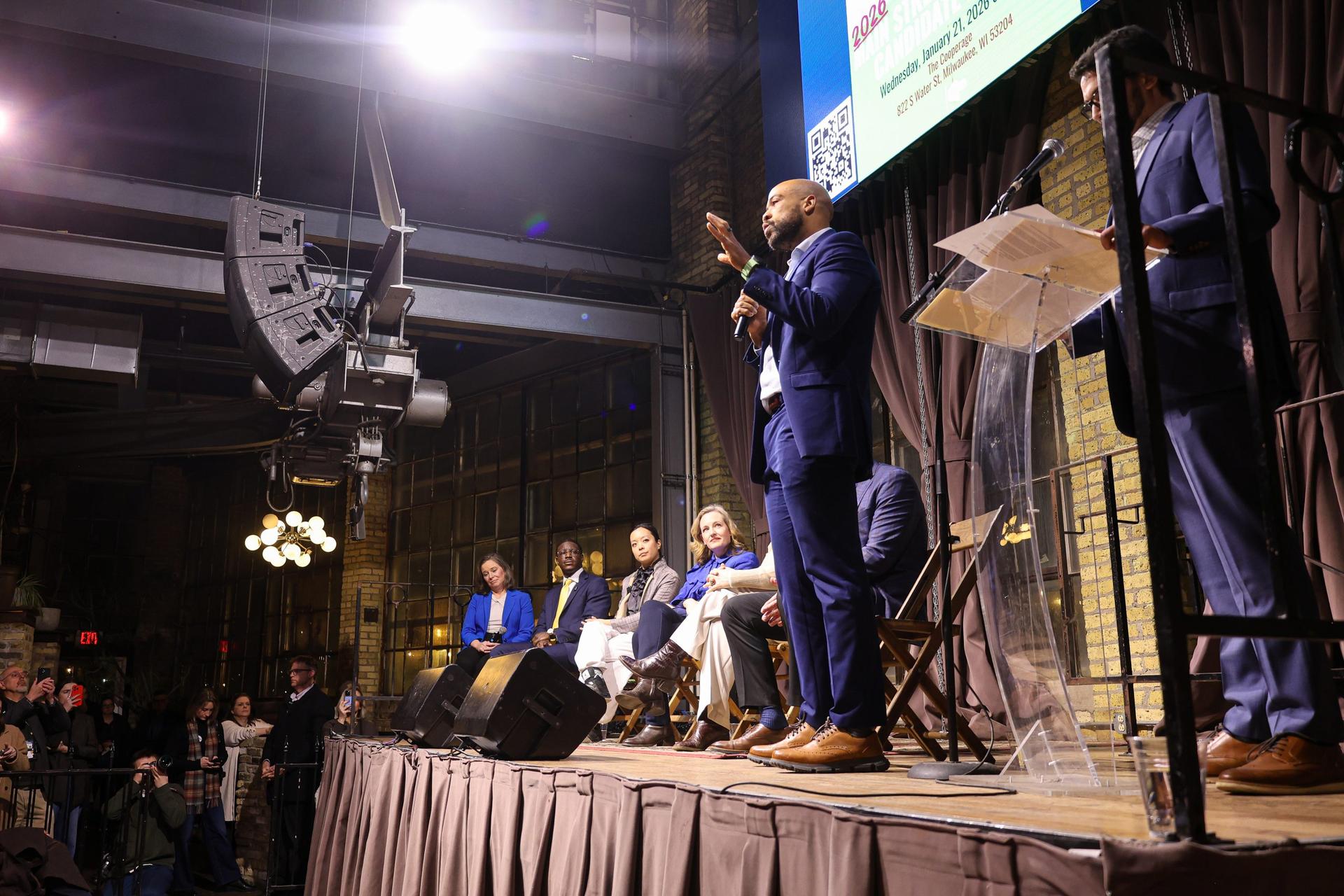
Source: Jennie Brand, Civic Media
Mandela Barnes argues utility companies have too little oversight and too much sway over pricing, wants to “freeze the rates”

Mar 23, 2026, 10:52 AM CT


Share
Health care, home care, child care, groceries, mortgage and rental payments, prices at the pump. Rising costs are hitting families hard from multiple directions these days. In Wisconsin, electricity bills continue to rise at a rate faster than eight other Midwestern states. In fact, energy rates in the state have exceeded regional averages for the last 20 years.
In a recent interview on “Daybreak with Brian and Jamie,” Democratic gubernatorial candidate Mandela Barnes linked rising utility bills to household budget decisions.
“We are struggling as Wisconsinites as we continue to pay higher costs and higher bills,” he said. “The money is there. It’s being spent in so many other directions. And I’m happy to work with responsible utility companies and those who want to do the right thing by their customers, but that’s just not the dynamic we’re experiencing right now.”
As of January, We Energies customers received a new, averaged rate increase of $7 per month for electric service and $4 per month for natural gas. The primary utility provider for Wisconsin and the Upper Peninsula of Michigan attributes the sticker shock customers are experiencing to natural gas prices and an increase in energy use during the winter months. In late 2025, the Public Service Commission of Wisconsin approved rate increases for three additional Wisconsin utility companies.
Barnes noted Wisconsin customers are seeing monthly bills spike by “up to $300 a month” at a time when energy companies are experiencing record profits. WEC Energy Group, the Milwaukee-based parent company of We Energies, reported $1.6 billion in net profits in 2025. As part of Barnes’ “Wisconsin Way” agenda, utility companies would face stricter limits and greater oversight on raising consumer prices under his administration.
Although he acknowledges fuel costs and major infrastructure upgrades as common drivers of increases in utility rates, Barnes argues regulators should examine the correlation between rising executive pay and increases in utility prices consumers are absorbing, putting a greater emphasis on consumer protection. He says Wisconsin’s energy providers have too much leverage over customers and regulators, and the state should tighten rules around what utilities can charge and how they operate.
Two central cornerstones to Barnes’ proposal are a freeze on utility rates and executive salary pay caps so companies, he notes, “can have some money left over for those capital expenses.”
Barnes is pledging to call for an end to a “revolving door,” where state regulators later take jobs with utility companies. His plan instead would be to sign into law a bill prohibiting utilities from using ratepayer funds for lobbying or political expenses. Limiting the pipeline, he argues, would strengthen public confidence that regulators are keeping the concerns of energy customers top of mind and acting independently.
Barnes’ plan, he said, includes closing loopholes that make ratepayers cover debts from closed coal plants, removing obstacles for renewable energy, providing tax credits for energy efficiency improvements, and ending reconnection fees for low-income families.
Among the issues driving the debate on energy costs is the rapid spike in data center construction across the state. These projects not only raise specific concerns, but they could also strap household budgets even further. Barnes is calling for a state study to look into their energy use, impacts on natural resources like water and land, and potential risks of air pollution. He also calls for ending non-disclosure agreements, requiring greater transparency during approval and construction, and mandating public reporting of energy use once a data center is up and running. “If they can’t adhere to these simple set of standards,” Barnes said, “then I don’t see a way where they should be developed and constructed.”
“It’s not a lot to ask for companies that are doing business in serving such a broad interest as utilities and energy which everybody needs,” Barnes argues. “It’s not far-fetched to call on them to act responsibly and see the challenge that people are facing instead of handing out these large CEO bonuses. You need to give the people some relief.”
Barnes’ plan for a utility rate freeze has faced some scrutiny, including a Milwaukee Journal Sentinel story questioning whether a rate freeze could work in practice. As concerns linger, the rest of the Democratic field has pitched similar alternatives — or none at all.
Lt. Governor Sara Rodriguez announced that she will issue an executive order to temporarily freeze utility rate increases and direct state lawmakers to develop a long-term plan aimed at reducing energy prices.
On the issue of data centers, State Rep. Francesca Hong, who is also running for governor, proposed a bill in February that would temporarily halt the development of large-scale data centers — legislation that fellow Democratic candidate Joel Brennan also supports. In an interview with WisPolitics, he promised to do the same.
In the legislature, Hong and State Sen. Kelda Roys are co-sponsoring Democratic legislation that would cap residential utility payments at 2% of a household’s income, prohibit service disconnections for households living at or below 300% of the poverty line, create an “Energy Burden Relief Fund,” and offer financial assistance to those spending more than 4% of their monthly income on utilities.
State Sen. Kelda Roys, also a candidate for governor, is co-authoring a bill that would require the Public Service Commission to establish a category for “very large customers” and implement a host of data center regulations. The goal is to make sure that ratepayers don’t end up footing the bill for the growing energy needs of data centers.
Missy Hughes, Milwaukee County Executive David Crowley, and Congressman Tom Tiffany, the top Republican in the race, all agree that utility costs are excessive and that data center development in Wisconsin needs state-level regulation. However, none of them have offered details on how they would reduce utility costs. Tiffany did release a political attack ad, though.
You can watch/listen to the entire interview with Mandela Barnes here:

Jennie Brand is Civic Media’s Community Manager, helping Wisconsites feel informed, represented, and heard. Reach out at [email protected].
Want More Local News?

Civic Media
Civic Media Inc.
The Civic Media App
Put us in your pocket.