







As data center developers stake out land in Wisconsin communities, much debate has surrounded whether the computer-packed warehouses will deliver economic benefits locally.
Waves of opposition and concerns about land, water and electricity use routinely follow data center proposals, while supporters echo that the centers will create jobs and help the economy.
But what jobs? How many of them? And will they last?
To answer those questions, Wisconsin Watch talked to three professors:
- Xiaofan Liang, who specializes in urban and regional planning at the University of Michigan.
- Scott Adams, a University of Wisconsin-Milwaukee labor economist.
- Dijo Alexander, who specializes in information technology, digital transformation and artificial intelligence at the University of Wisconsin-Milwaukee.
Here are some takeaways.
What kinds of jobs do data centers bring?
Data center jobs fall into three major categories that represent phases in their creation:
- Development
- Construction
- Operations
A data center first needs people to plan for its existence. Developers, engineers, designers and planners lay that groundwork.
“The data center industry as an ecosystem is pretty big … When they first introduce a data center to a place, they have to figure out the design standard, how to construct all kinds of facilities, how it connects to city systems,” Liang said.
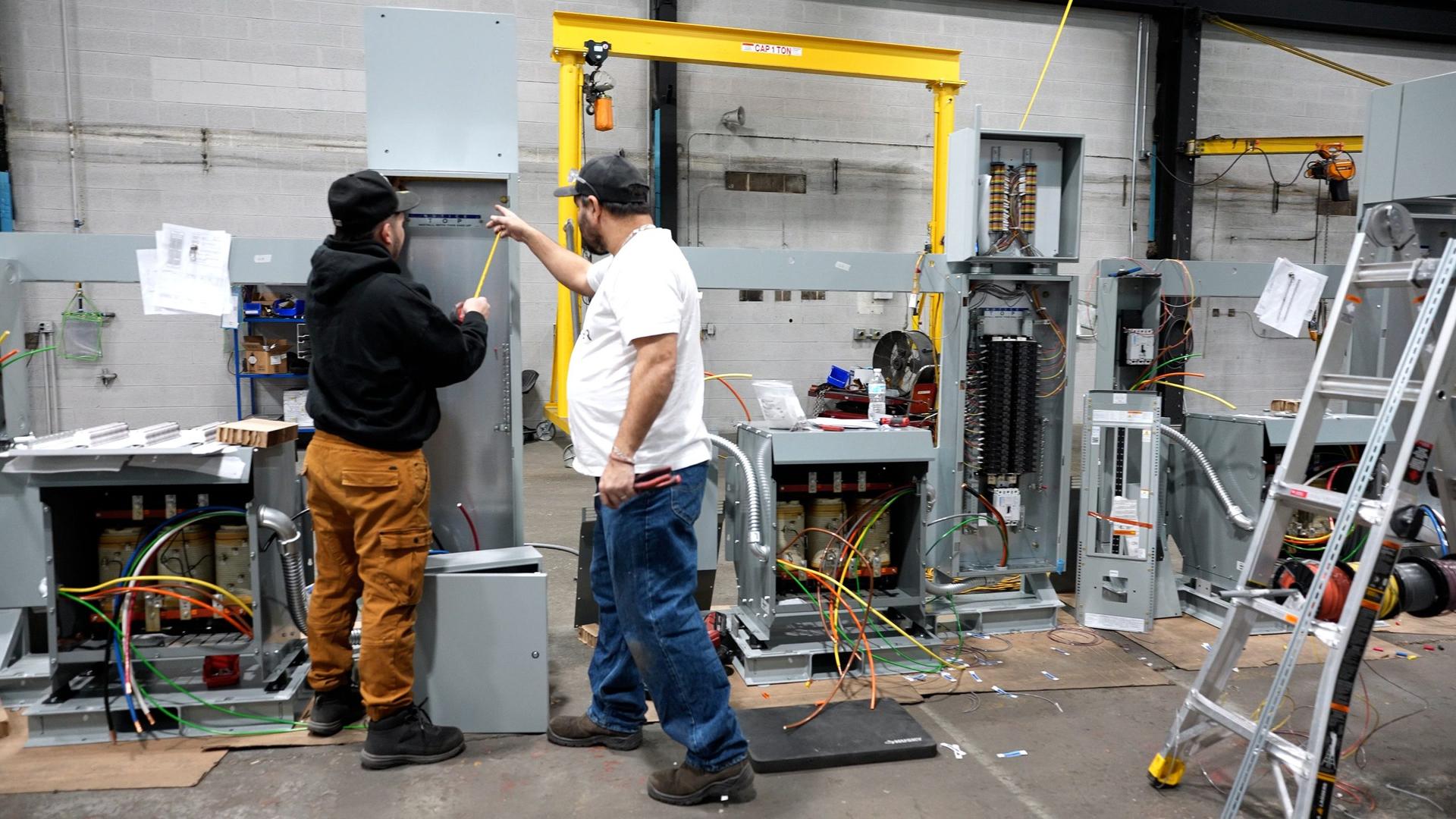
Then, developers must hire heaps of hands-on laborers to construct the gigantic warehouses from the ground up — the largest portion of workers needed in creating and operating a data center. Among other professions, this includes electricians, plumbers and pipefitters, carpenters, structural steel and iron workers, concrete workers and earth drillers.

The job boom from early phases fizzles out once the building is complete, Liang said.
“(During) construction time, you usually have a lot more jobs — maybe 10 times in magnitude more so than operations,” Liang said.
Operations jobs, fewer in quantity, are largely “unglamorous,” Adams said.
Some of these roles have relatively low barriers to entry, such as maintenance workers and security guards. Meanwhile, electricians and HVAC workers are needed, considering that power and cooling are data centers’ “two most important inputs,” Adams said.
Adams echoed a popular analogy likening data centers to warehouses full of rotting bananas that need constant cooling and replacing.
“You need banana technicians, more or less, that take the rotted bananas out and replace them with new bananas,” Adams said. “Now, granted, they’re much more expensive bananas in there, and they’re doing a whole lot, and it requires a little more expertise. But again that expertise, by and large, can be developed pretty quickly.”
Those workers will be data center technicians — people who install servers, replace hardware and cables, monitor systems and notice when things break down.
How many jobs do data centers bring?
The number of jobs created depends on a data center’s size, Liang said.
That can initially mean thousands of jobs at gargantuan developments like in Mount Pleasant. Microsoft says it has employed 3,000 people to construct the location, compared to 500 full-time workers once the plant is operating. But these numbers are expected to climb as the company constructs a cluster of additional centers at the site.
Not all of these workers will be local. Given the temporary high demand, the projects will likely need out-of-town construction laborers who travel to the area and don’t stay long term.
Smaller projects will employ far fewer people. For a typical data center, Microsoft estimates it hires about 50 full-time employees. What those numbers mean for the local area depends on the community’s size.
“In a bigger city, like Atlanta, it’s like a drop in the ocean, right? It doesn’t really affect much,” Liang said. “In a rural area, in a smaller town, hundreds of jobs … are a big deal.”
What about the trickle-down economic benefits?
A sizable new employer entering communities could ripple across other nearby industries, though Liang notes this is hard to measure.
“(A data center) just has such a big infrastructure need that trickles down in many different ways,” Liang said. “Now we need expanded utility infrastructure, grid, fiber, water, all these things. Construction of these infrastructure, even though it’s not directly related to (a) data center, could increase local employment in those areas.”
Inside a data center are “cabinets after cabinets of steel frames holding computers” that need to be built, Alexander said. This can boost local manufacturing, especially the metal fabrication industry.
Wisconsin manufacturers have already begun cashing in on the construction boom nationwide. As Wisconsin Watch previously reported, just three Wisconsin companies alone have amassed more than $1 billion in equipment sales — such as motors, generators and cooling systems — to data centers.

Massive developments like Microsoft’s in Mount Pleasant can potentially lead to a “tech corridor,” a cluster of warehouses and manufacturers near the data center they serve, Alexander said.
“If we take the initiative and if we bring a few big enough component manufacturers, we can create locally created components for these data centers to consume,” Alexander said. “It’s like if you have a big restaurant or food manufacturer here, you will have agriculture around there, because it is easy for you to bring your produce for their consumption. Just like that. ”
The trend could also activate industries like nuclear power, Adams said. Building data centers in conjunction with nuclear reactors to generate their power would fuel even more construction and energy jobs, he added. In Kewaunee County, an energy company wants to rebuild Kewaunee Power Station, a defunct nuclear power plant, anticipating energy demand from AI and data centers.
In more rural communities or near smaller data centers, the trickle-down effects could prove more modest — perhaps a few new restaurants and housing units, Adams said.
Alexander also noted the effects could also be less concentrated, with growth spilling into neighboring cities as employees work at the center but live elsewhere.
But will enough permanent jobs be created to sustain the growth sparked during the early labor-intensive development phase? That’s unclear, Adams said.
“We don’t have a firm enough grasp about the indirect effects in the longer term,” Adams said. “Short run, that’ll be great. Longer run, can we sustain the new development that might happen around these? I don’t know the answer to that. I think if the power generation side of it comes in connection with them, there’s more of a chance that that will work.”
Who are data center technicians?
Data center technicians are perhaps the most novel job introduced by the data center boom. The roles are more specialized than others needed inside the warehouses.
Job postings for data center technicians at Microsoft’s Milwaukee location say the workers will be “preparing, installing, performing diagnostics, troubleshooting, replacing, and/or decommissioning equipment under the guidance of more experienced data center colleagues.”
The posting states the job requires a high school diploma, knowledge of computer hardware and some experience with IT equipment. Pay for lower-level technicians ranges from $23 to $36 per hour, with more experienced workers making up to about $48 per hour.
Adams said likely candidates will include engineers and computer coders and people now entering college with their sights on data center work. Microsoft and Gateway Technical College in Kenosha launched a “Data Center Academy,” preparing students to work in data center operations. Adams believes partnerships like this will become more common.
Are these good jobs?
You can use the interactive table below to explore many of the jobs data centers are expected to create, including wages, employment totals and required education.