





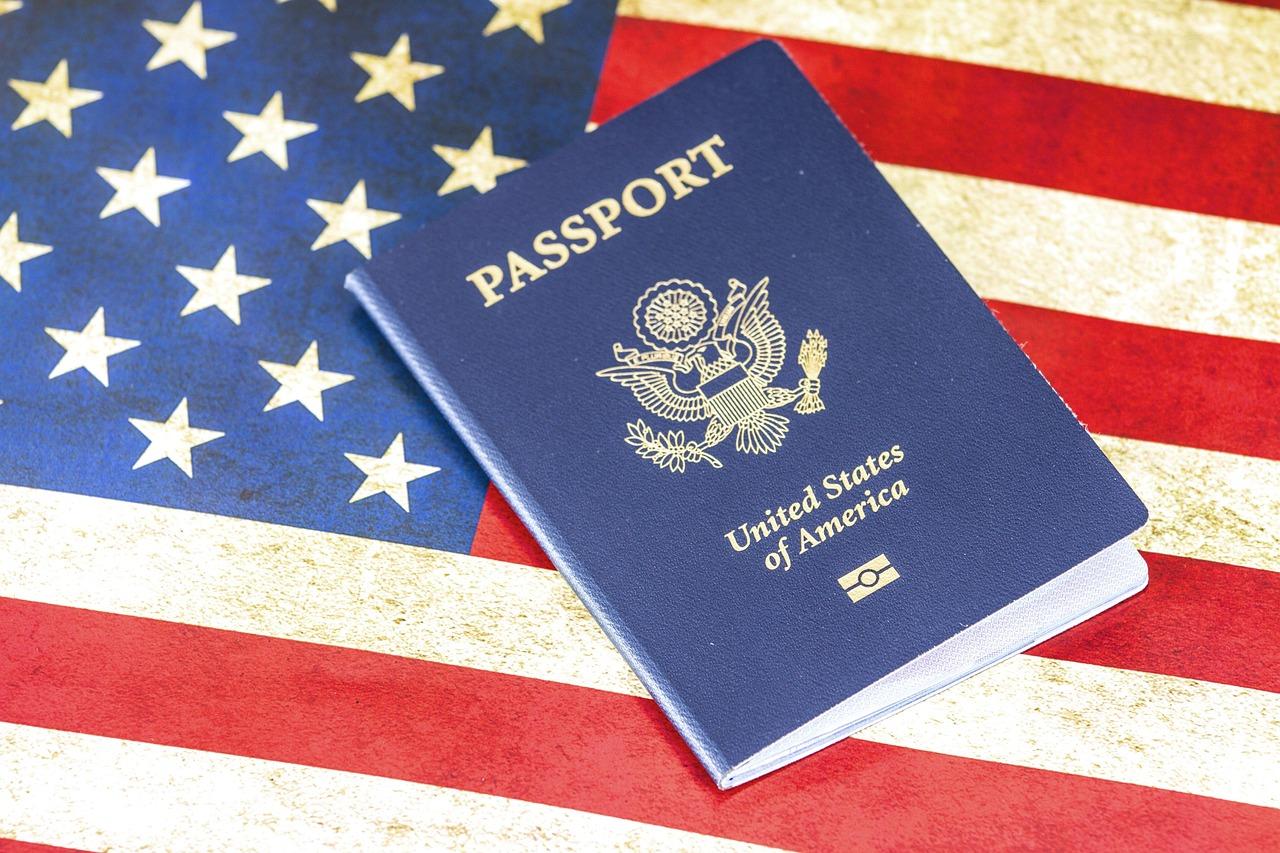
Source: Photo by cytis on Pixabay
What if everyone had to prove their citizenship to register to vote?
Feb 16, 2026, 8:58 AM CST


Share

This news analysis was originally distributed in Votebeat’s free weekly newsletter. Sign up to get future editions, including the latest reporting from Votebeat bureaus and curated news from other publications, delivered to your inbox every Saturday.
Presidents’ Day is always the hardest holiday to shop for; it’s hard to know what to get the president in your life. But the U.S. House of Representatives got President Donald Trump exactly what he wanted when it passed the SAVE America Act on Wednesday.
The act, which passed with the support of all 217 House Republicans but only one Democrat, is a centerpiece of Trump’s agenda to exercise more federal oversight over elections and prevent illegal voting, which is already very rare. It’s essentially version 2.0 of the SAVE Act, which passed the House last year.
Like its predecessor, the SAVE America Act would require people who are registering to vote to provide proof of their U.S. citizenship. (Currently, new registrants only have to attest under penalty of perjury that they are citizens.) This version of the bill also adds a photo ID requirement for voters and requires states to run their voter rolls through the Department of Homeland Security’s Systematic Alien Verification for Entitlements database to scan for noncitizens. All provisions of the bill would take effect immediately upon enactment.
But enactment is unlikely. The filibuster rule effectively means that legislation needs 60 votes to pass the Senate, and Republicans hold only a 53-47 majority in the upper chamber. Some Republicans are pushing to turn the filibuster from a procedural formality into a literal requirement that Democrats hold the floor and talk indefinitely in order to block the bill, which could allow the bill to pass with a simple majority if Democrats run out of steam. But that would derail the Senate for weeks, and Senate Majority Leader John Thune isn’t making encouraging noises.
If the bill does somehow become law, though, it would dramatically shake up how the 2026 elections run. Only three states currently require all newly registering voters to prove their citizenship, and 27 states don’t require photo IDs to vote, so the bill would suddenly impose new requirements on millions of Americans.
And there are serious questions about whether it’s even practically possible to implement them all in time for the midterm elections. Election officials are sounding the alarm about how the bill would force them to build out entirely new procedures without the time or money to do so.
The SAVE America Act could stymie potential voters
The proof-of-citizenship requirement in particular would be a hassle for potential voters and election officials alike. According to a 2023 survey conducted by SSRS on behalf of the University of Maryland and three voting-rights groups, 9% of voting-age citizens don’t have easy access to a document that proves their citizenship, such as a passport, birth certificate, or naturalization certificate.
Even people with the correct paperwork could be confused or inconvenienced too. Several election officials have compared a proof-of-citizenship requirement to the Transportation Security Administration’s slow rollout of REAL ID requirements. That policy was repeatedly delayed amid confusion over what documents were necessary to get a REAL ID and bottlenecks at driver’s license agencies.
The SAVE America Act would also effectively neuter the option to register to vote by mail or online, since new registrants would have to show up in person with their documentation.
In states that have already tried to implement proof-of-citizenship requirements, many eligible voters ended up getting disenfranchised. After Kansas started requiring proof of citizenship in 2013, 31,089 people were unable to register because they couldn’t prove their citizenship. That amounted to 12% of all the people who tried to register to vote in Kansas during that period. By contrast, the state could identify only 39 confirmed noncitizens who had registered to vote in the previous 14 years.
A court struck down Kansas’ proof-of-citizenship law in 2018.
An election administration ‘nightmare’
“This is bad for voters, but this will be a nightmare for election administrators,” Minnesota Secretary of State Steve Simon, a Democrat, told Votebeat.
Multiple election officials said that adding document verification to their already very full plates was a logistical burden that they were not prepared to assume. Many felt that it was simply not possible to implement a proof-of-citizenship requirement in time for the midterms, especially since the SAVE America Act does not provide them with additional funding to, for example, hire more staff to review documents.
“We are going to have significant challenges training all of our clerks and registrars to uniformly verify citizenship,” said Maine Secretary of State Shenna Bellows, a Democrat. “We will have to create the training from scratch, and we don’t have the personnel to travel to all 487 municipalities [in Maine] to make sure that they’re doing it right.”
“If Congress wants to do this,” she said, “they should give the states the proper runway of multiple years and millions of dollars of funding per state.”
Justin Riemer, the president of the group Restoring Integrity and Trust in Elections, which has advocated for proof-of-citizenship requirements, was more optimistic that states were up to the task. “States will undoubtedly have to move very quickly to implement this legislation,” he said, “but there is precedent, as states did [quickly change their voting procedures] during the COVID-19 pandemic.”
Riemer pointed out that a plurality of new voters already register through their state department of motor vehicles, whose staffs are already well trained in document verification thanks to the REAL ID requirements.
A proof-of-citizenship requirement would undeniably cost election officials more time and money, though. According to a social media post by Bob Page, the registrar of voters in Orange County, California, the county conducted an analysis last year of what it would have taken to prove the citizenship of the 633,568 people who registered to vote or updated their voter registration in 2024. The study found that, at an average of 10 minutes per applicant whose documentation needed to be verified, the county would have needed to hire 59 additional staffers at a cost of $6 million.
And according to a report from the Campaign Legal Center, proof-of-citizenship laws cost Kansas and Arizona (one of the three states where the requirement is currently in place) millions of dollars — in additional staffing, voter-education efforts, system upgrades, fixing errors, and defending against lawsuits over the requirements.
Ultimately, as long as the filibuster remains in place in the Senate, the SAVE America Act has little chance of becoming law before the midterms.
But that may be the point: The bill wasn’t introduced with the goal of making elections run more smoothly; it was introduced to make the point that elections aren’t as secure as they could be. If, as expected, the bill fails and voters don’t have to prove their citizenship or show photo ID in 2026, it could make it easier for Trump and his allies to claim that the results are tainted by fraud. That could be a different type of nightmare scenario.
Nathaniel Rakich is Votebeat’s managing editor and is based in Washington, D.C. Contact Nathaniel at [email protected].
Votebeat editor-in-chief Carrie Levine contributed.
Votebeat is a nonprofit news organization covering local election integrity and voting access. Sign up for their newsletters here.

Want More Local News?

Civic Media
Civic Media Inc.
The Civic Media App
Put us in your pocket.