Source: Canva / Civic Media
State Lawmaker Warns Special Education Funding Shortfall Will Drive Property Taxes Even Higher
Class in Session: Rep. Angelina Cruz says state’s promised reimbursement rates are falling short, leaving school districts to fill gaps through local levies

Jan 15, 2026, 6:54 PM CST


Share
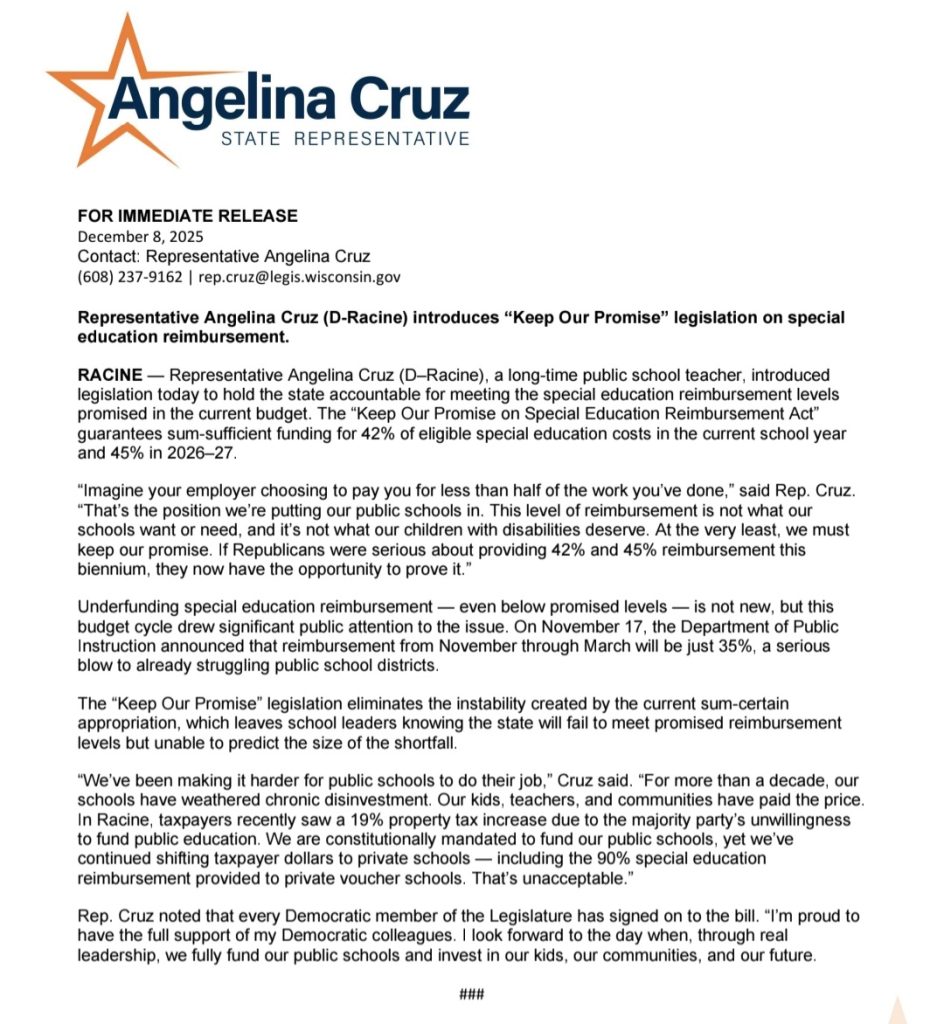
A Democratic state lawmaker warns Wisconsin school districts are facing an unexpected budget shortfall after state projections show special education funding will come in well below levels promised in the last state budget.
Rep. Angelina Cruz is a former public school teacher and says new estimates from the Department of Public Instruction (DPI) indicates districts will receive roughly 35% reimbursement for special education costs. That’s despite lawmakers approving a 42% reimbursement rate this year and 45% next year in the biennial budget.
“The difference is massive for local school districts,” Cruz explains during a discussion with Tim Slekar and Johnny Lupinacci, hosts of Busted Pencils. “Districts were told they could rely on this funding, and now they’re being left to make up the gap.”
Listen to the full discussion here:
[podcast src="https://civicmedia.us/shows/busted-pencils/2026/01/14/do-what-you-say-class-in-session"]Republican lawmakers touted the reimbursement increase as a historic investment when the budget passed, Cruz shares, despite allocating no new general aid funding for public schools during the two-year budget cycle. Many districts rely on the promised reimbursement rates when planning their budgets.
Also according to Cruz, the discrepancy stems from the budget’s use of “sum certain” funding. It’s a fixed dollar amount rather than “sum sufficient” funding, which would guarantee reimbursement at a set percentage regardless of rising costs.
“Special education costs fluctuate,” Cruz says. “Staffing, services, and student’s needs change, and a fixed amount doesn’t account for that reality.”
Cruz says district officials are now scrambling to close the gap. It’s a situation she argues will further increase pressure on local property taxes as schools will turn to referendums to maintain basic operations.
She introduced legislation known as the “Keep Our Promise” bill, which would require the state to meet the 42% reimbursement level this year and 45% next year by changing the funding language to “sum sufficient.” The proposal is currently circulating for co-sponsorship.
“Every Democratic lawmaker has signed on so far,” Cruz says. “Not a single Republican has.”
Cruz also argues that failing to fully reimburse special education costs conflicts with Wisconsin’s constitutional requirement that the state provide a free and uniform public education.
“When we don’t fund special education, districts are forced to raise property taxes or cut programs,” she explains. “That’s not a budgeting accident. That’s a policy choice.”
Republican legislative leaders have blamed DPI and Gov. Tony Evers for the funding shortfall. But those are claims Cruz calls inaccurate. She says the Legislature could have avoided the situation by funding per-pupil guarantees through the state budget rather than pushing costs onto local communities.
“If the state would keep its promise, school districts wouldn’t be pitted against their taxpayers,” Cruz said.
Teri Barr is Civic Media’s Content Creator and a legend in Wisconsin broadcast journalism. Email her at [email protected].
Want More Local News?

Civic Media
Civic Media Inc.
The Civic Media App
Put us in your pocket.